
Numismatics often corrects assumptions shaped by history.
Beginner collectors frequently associate the year of the twentieth president's death with the production of commemorative gold currency.
James Abram Garfield entered office in March 1881 and passed away in September of that same year.
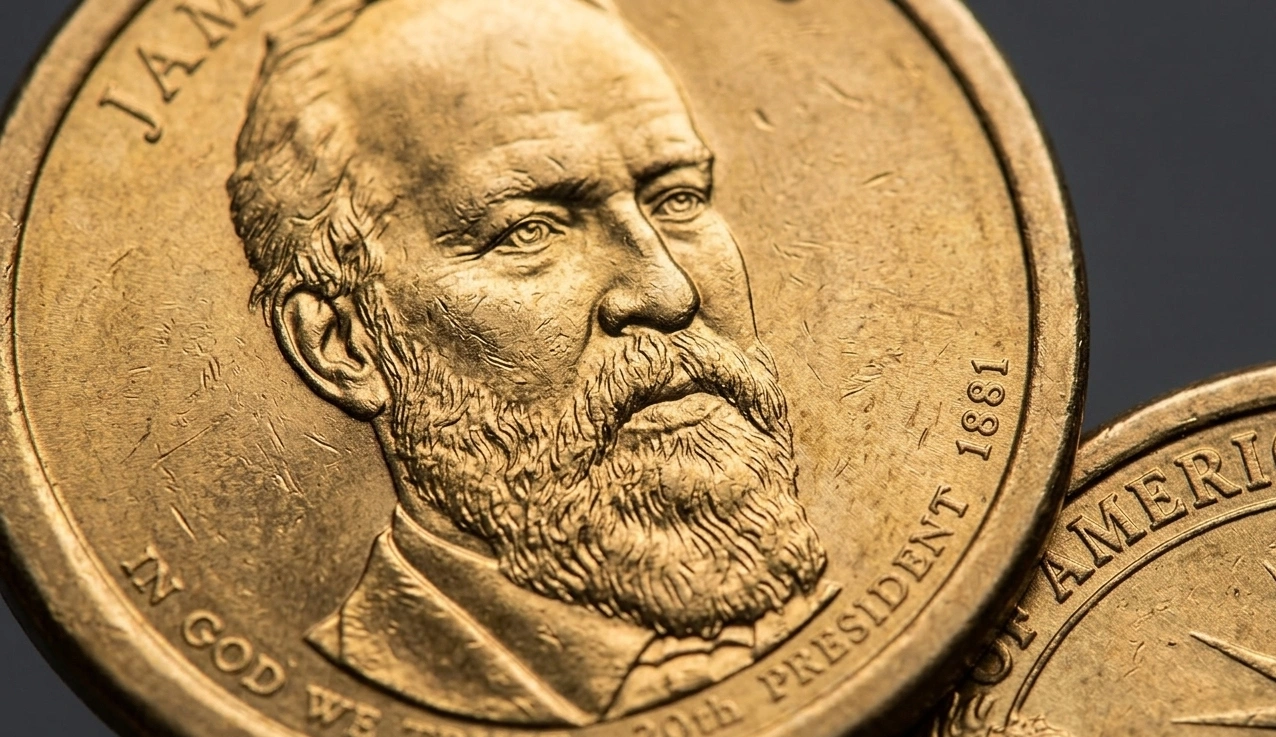
The dates 1881 and 2011 appear on different sections of the James Garfield gold dollar coin 1881.
1881 Issue Characteristics | Description |
Metal Content | 90 percent Gold |
Proof Mintage | 87 pieces |
Business Mintage | 7,750 pieces |
Obverse Design | Liberty Head |
2026 Market Value | $5,500 - $12,500 |
The minting of commemorative coins featuring presidential portraits began much later in history.
Timeline of the Garfield Portrait on Dollar Coins
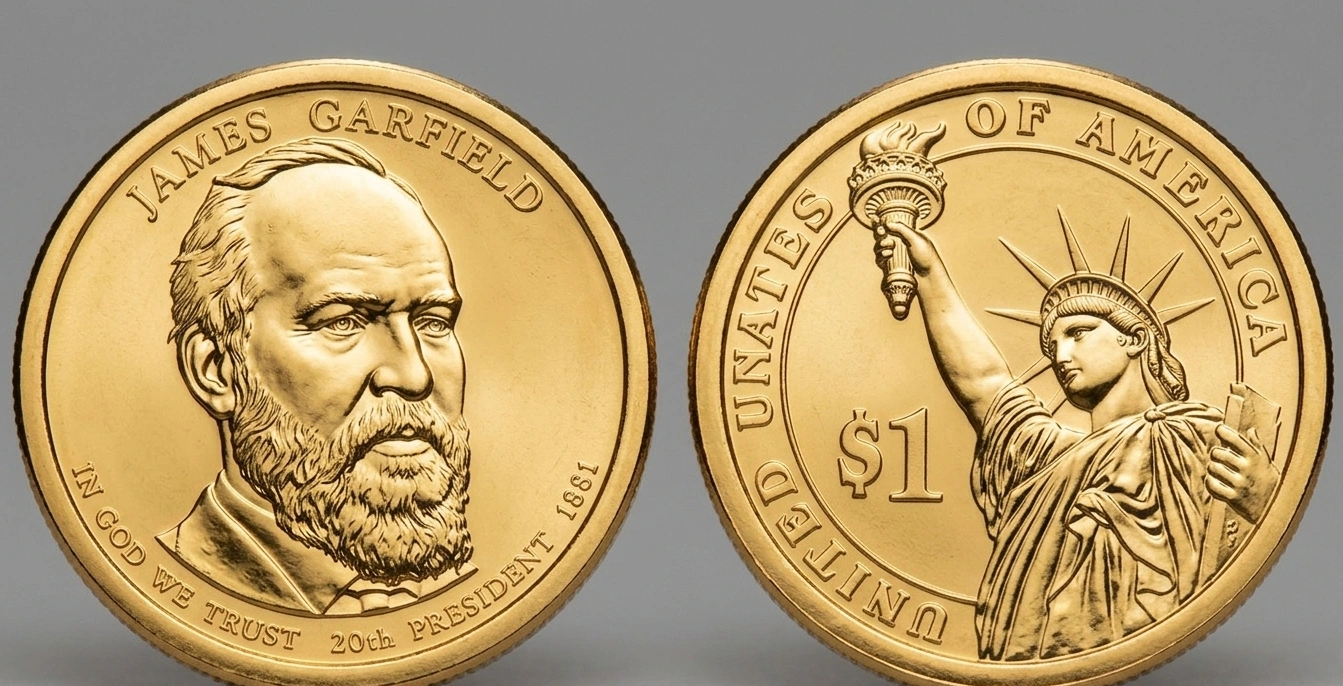
The first official appearance of James Garfield on a one-dollar coin happened within the Presidential Dollar program.
Congress passed this specific law only in 2005.
The series utilized non-precious metals consisting of a copper core.
A visual similarity between the alloy color and real gold misleads inexperienced owners.
Factors preventing gold issues in 1881:
Absence of legal act → Lack of approved die → Zero physical specimens.
Comparative Data for Modern Garfield Coins
Modern 2011 issues often face misidentification as antiques due to the life dates of the president.
Parameter | Value |
Material | Yellow Brass over Copper |
Mass | 8.1 grams |
Diameter | 26.5 mm |
Edge | Incuse lettering with date |
Nominal Value | $1 |
Annual price growth for these coins in MS68 condition averages 4 percent of the base value.
Coins found in circulated condition maintain only their face value without increase.
Authenticity Verification and Error Analysis
The existence of an 1881 gold dollar with Garfield is disproven by the total lack of entries in the National Numismatic Collection.
Private tokens or gold-plated copies occasionally enter the market.
These items carry no status as legal tender.
Investment appeal for such fakes remains at 0 percent.
Steps for identifying a counterfeit:
Weighing the item → Using the free coin identifier app →Comparing with official catalogs → Inspecting edge lettering.
A mass deviation exceeding 0.2 grams indicates a non-authentic material.
Price Dynamics for Certified 2011 Specimens
A record price for a 2011 Garfield coin in perfect condition reached $1,250.
Standard circulation coins follow these pricing statistics in 2026.
Grade MS65: $4
Grade MS66: $12
Grade MS67: $45
Grade MS68: $900
Price changes based on condition:
Moving from MS67 to MS68 → 1,900 percent price increase
Surface scratches appearing on the obverse → 90 percent price drop
Professional Certification PCGS confirms the non-existence of 1881 gold prototypes.
Technical Limitations of the 19th Century Mint
Philadelphia Mint machines in 1881 required manual feeding for gold coin blanks.
Creating a new image type demanded months of engraving work.
Chief Engraver Charles Barber produced no dies featuring Garfield during that period.
The president's death triggered the release of mourning medals rather than coins.
Medals featured different weight characteristics and lacked a denomination.
Hoaxes and Private Releases
Private companies sometimes manufacture commemorative items mimicking old coins.
These products often omit the word Liberty.
The absence of a mint mark on an 1881 gold dollar serves as a reason for detailed inspection.
Scrap value in such items matches the current market price of the metal.
No numismatic premium exists in these cases.
Archival Documents and Treasury Reports
The 1881 Report of the Director of the Mint contains a full list of minted denominations.
This document lists only dollars featuring the Liberty image.
Year-end die inventory revealed no hidden or experimental patterns.
Production costs for a single gold dollar coin in 1881 amounted to $1.02.
High manufacturing expenses caused the permanent cancellation of gold dollar production in 1889.
Demand for the Presidential Series in 2026
In 2026, interest in Garfield coins remains stable among type-set collectors.
The total mintage for the 2011 coin reached 74,200,000 pieces.
Such a massive quantity prevents any genuine scarcity.
Exceptions exist for coins featuring minting errors on the edge.
Error statistics:
Missing edge lettering — 0.01 percent of mintage.
Doubled edge lettering — 0.005 percent of mintage.
Prices for coins missing edge text reach $150.
Comparison with Other Presidential Issues
Garfield is not the only leader whose image is sought on 19th-century gold.
Similar questions arise regarding Lincoln and Grant.
The only president appearing on coins during his lifetime in the 19th century was Washington on early trials.
Standardization of portraits on circulating coins began only in 1909.
Previously, the law forbade using faces of real people on money.
Practical Advice for Investors
Buying coins with an 1881 date requires requesting a certificate of authenticity.
Verification through the NGC or free coin value lookup database is mandatory.
Items missing from these databases are considered fakes.
Garfield coin liquidity levels in 2026:
Standard $1 — High at face value
Grade MS67 — Medium
Rare Errors — Low requiring an auction
Annual losses from purchasing fakes sold as rarities amount to millions of dollars.
The Role of Numismatic Catalogs
Krause and Red Book catalogs contain no mentions of an 1881 Garfield gold dollar.
These sources represent the fundamental basis for verification.
Any physical characteristic mismatching the Red Book description indicates a copy.
The weight of a genuine 1881 one-dollar gold coin must be exactly 1.672 grams.
Exceeding this weight while featuring a Garfield portrait confirms a modern origin.