
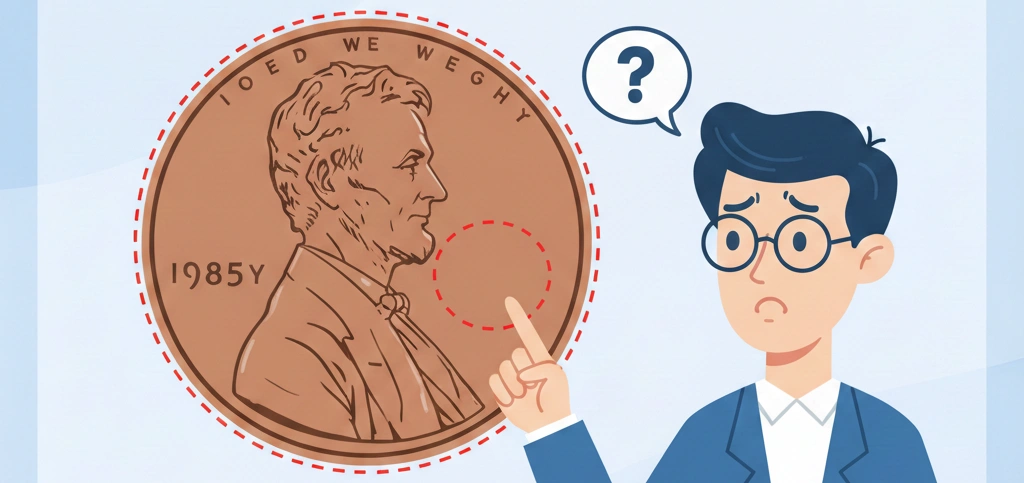
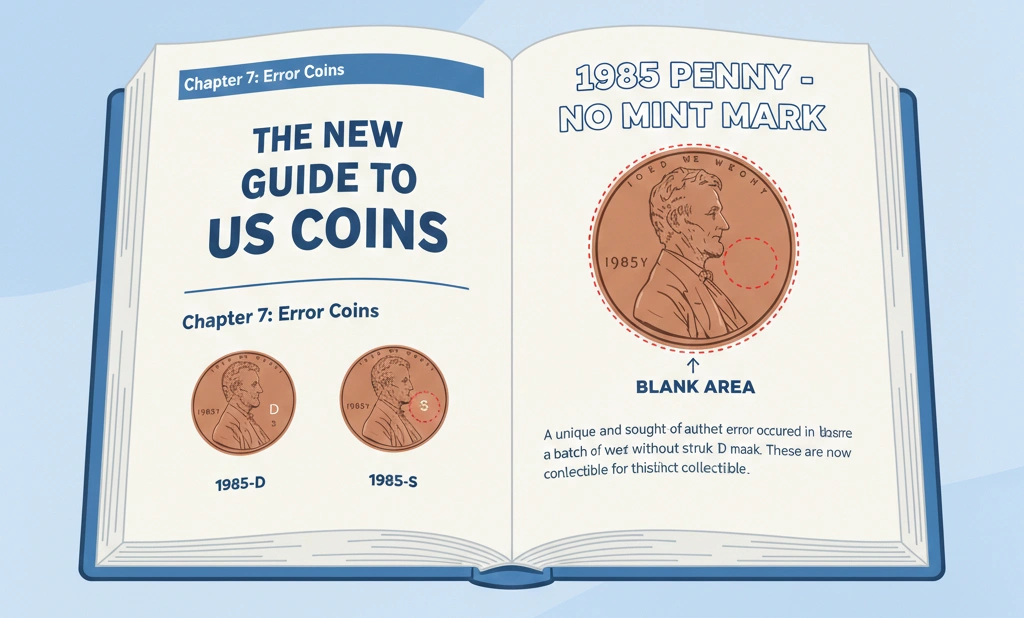
The absence of a mint mark on American small-denomination coins traditionally indicates their production at the main facility in Philadelphia.
The Philadelphia Mint did not utilize letter markings for Lincoln Cents in 1985.
This practice represents a standard procedure for the specified production period.
The total mintage of this 1985 penny no mint mark coin type in 1985 reached 5,648,489,887 specimens.
The 1985 coin belongs to the "Copper-Plated Zinc" type, introduced into circulation in mid-1982.
The transition to a new alloy resulted from rising copper prices on the global market.
Parameter | Value |
Core Composition | 99.2% Zinc |
Plating Composition | 0.8% Copper |
Total Weight | 2.5 Grams |
Diameter | 19.05 mm |
Thickness | 1.52 mm |
Edge | Plain |
Utilizing a zinc core significantly reduced the item's mass compared to pure copper counterparts weighing 3.11 grams.
A thin layer of copper is applied via electroplating, ensuring protection for the zinc against rapid corrosion.
Condition Analysis and Grading
The value of the coin correlates directly with its preservation, determined by the 70-point Sheldon Scale.
Coins found in circulation belong to the "Circulated" category and are valued at face value.
Specimens in Mint State (MS), starting from the MS65 level, possess investment value.
Characteristics of Color Categories
Professional grading services like PCGS, a free coin identifier app, and NGC utilize three color designations for Lincoln Cents:
Brown (BN): Coins having lost more than 95% of their original luster.
Red-Brown (RB): Specimens retaining between 5% and 95% of the original red copper color.
Red (RD): Items retaining more than 95% of the original mint luster.
Maximum price records are recorded exclusively within the Red category.
Auction Price Statistics and Market Dynamics
The market value of 1985 no-mint-mark coins demonstrates stability at lower grades and a sharp increase upon reaching higher scores.
Below is a table of approximate market values based on recent auction data.
Condition | Color | Average Price (USD) | 5-Year Change (%) |
MS65 | RD | $10 - $15 | +2% |
MS66 | RD | $25 - $40 | +5% |
MS67 | RD | $150 - $250 | +12% |
MS68 | RD | $1,500+ | +25% |
Record-Breaking Sales
The highest price for a 1985 Philadelphia specimen was recorded in 2014 at Heritage Auctions.
A coin in MS68 RD condition sold for $5,875.
Currently, the number of known specimens in MS69 RD grade remains extremely limited, making their appearance at auctions a rare event.
Identification of Manufacturing Defects and Varieties
No major systemic errors comparable in significance to the 1955 doubling were recorded in Philadelphia during 1985.
However, specific defects increasing numismatic value do occur.
Double Die Obverse (DDO)
Doubling of obverse elements happens due to a die defect receiving a repeated impression with a slight offset.
Microscopic doubling on 1985 coins is found on the date digits and "LIBERTY" inscriptions.
The value of such specimens ranges from $20 to $100 depending on the prominence of the effect.
Mint Errors
Off-Center Strike: A coin struck with an offset beyond the planchet boundaries.
Specimens with an offset exceeding 50% while maintaining date readability are valued at $50 - $150.Die Cracks: The appearance of raised lines on the coin surface caused by the failure of the working tool.
Special interest is given to "BIE" errors occurring when a crack appears between the letters in the word LIBERTY.Plating Bubbles: A defect caused by gas or contaminants trapped under the copper layer.
This phenomenon is considered a flaw lacking high collector value, often reducing the coin's grade.
Comparing mintage volumes allows for an assessment of the relative rarity of 1985 coins.
Mint | Mark | Mintage |
Philadelphia | None | 5,648,489,887 |
Denver | D | 5,287,399,926 |
The difference in mintage amounts to less than 7%, making both coins equally accessible in circulation.
However, no-mint-mark specimens in ideal condition (MS68 and above) appear less frequently than Denver counterparts according to PCGS Population Report statistics.
Factors Influencing Long-Term Value
Inflationary processes and changes in metal costs minimally affect the price of rare grades.
Market demand for filling slots in Registry Sets acts as the primary price driver.
The percentage increase in price for top categories (MS67+) over the last 10 years reached approximately 150%.
Meanwhile, mid-quality coins (MS63-MS65) lost about 10% in real value considering dollar inflation.
Coin Verification Instructions
Accurate evaluation of a 1985 specimen requires the completion of the following stages:
Weighing the coin on electronic scales with 0.01g precision to exclude counterfeits or identify rare planchets.
Examining the surface with the coin checker app allowing for the detection of cleaning traces or artificial toning.
Comparing the color against Red, Red-Brown, and Brown reference samples.
Checking for the presence of the "D" mark under the date, the absence of which confirms Philadelphia origin.
Any mechanical impact on the surface, including wiping with cloth, destroys the mint luster, reducing the value to face value.
Conclusion
The 1985 one-cent coin without a mint mark is a mass-produced product of the American monetary system.
The value of this issue is concentrated in extremely high states of preservation achieved only by avoiding contact with other objects after striking.
Studying mintage data and auction records confirms the coin's status as an accessible yet potentially valuable object, provided the surface quality remains exceptional.